Friday, December 01, 2006

Late Medieval Europe and the Early Italian Renaissance

Dress in Late Medieval Europe & The Early Italian Renaissance 1350-1500ce


The trend towards greater extravagance in dress, found in the 11th -13th centuries, increases throughout this whole period. Several factors were at work pushing high fashion towards greater and greater consumption: increased exports from the East in the wake of The Crusades, increased production and improved quality of textiles in the West, the wealth of a rising urban tradesman class, and the sudden increased inherited personal wealth of the survivors of the Black Plague (1350-1400).
In Italy these factors operated at a peak because fine fabric production and importation was the cornerstone of the Northern Italian economy. Huge fortunes were made in the Florentine and Venetian city republics by merchants and manufacturers who had no lands or titles with which to claim nobility. These wealthy merchants sought out a way to buy the status that they craved. With fabric as their stock in trade they dressed more lavishly than the landed nobility, and spent fantastic sums on private and public art and architecture to gain social recognition


Young Venetian Gentlemen of the 15th Century from Stibbert

The competition in dress took a new twist in this period. Once one has enough gowns and surcoats in the finest fabrics, and all your peers have the same, how do you compete? Conspicuous consumption will only take you so far, you can only wear one set of clothes at a time. This is when Western dress took it's long trip into fashion and fads. The Italians began to take fabric and cut it and piece it in a complex fashion to fit close to the body, and have a recognizable "cut" that could be adopted and discarded as a "fashion". By combining the intricate cut, piecing and fit usually found in skin-sewn cultures and applying it to fabric, the Italians acquired the means to make clothing with a planned obsolescence. This meant that (as now) clothing could go out of fashion faster than it would wear out. This put anyone, even an aristocrat, without the means to continuously buy new clothing in a place somewhat lower than that of the very rich.
Northern Europe to a lesser degree went through a similar change at this time. Many villages and small towns grew into cities in this period, buoyed up by the wealth that the tradesmen who lived in them generated. Cities did not fit into the feudal social structure of the time, and so had to develop social structures of their own. Not surprisingly they too adopted fashion as a marker of wealth and status, and the fashions of the cities came to be the fashions of the courts and aristocracy.


French women's headdresses of the 15th Century (Stibbert)

As a result this era had a lot of different fashionable garments and accessories in it, a number of which were quite extreme in style. Poulaines were long pointed shoes, worn mainly by men in Northern Europe, these shoes had padded toe points that could extend as far as a full foot length in front of the foot itself, and often present a rather phallic appearance.


15th Century poulaines

Other fashion extremes included the Hennin, a woman's conical headdress popular in Northern Europe of the 15th Century, The Chaperon, a turban like headdress worn in Italy and the North, The Houppelande, a graceful unisex gown which used an amazing quantity of fabric both on the body and trailing on the ground, and parti colored dress, a fashion of piecing many different fabrics together into a single garment, and then there is the Codpiece a padded section of a man's hose intended to contain the sex organs.

Both in the North and in Italy, dress got progressively longer, and more vertical in line as the 15th Century went on. By 1500 upper class dress is heightened by headdress, lengthened with trains and hanging sleeves, and appears to be drawing an obvious parallel with the verticality of the late Gothic religious architecture of the time.

Grand seigneur wearing a houpplande and chaperon, c.1410


Great ladies c. 1450 wearing hennins


12th-15th Century French dress from Racinet.


12th-14th Century men's dress from Racinet.

Tuesday, November 14, 2006

Byzantium


Dress in Byzantium (400-1460ce)

Dress in the Eastern Empire, later to be called Byzantium by the West, (although properly called Romania at the time) was directly taken from the later Roman Empire. Strictly speaking Byzantium/Romania was the late Roman Empire, although it's capitol was Constantinople, and it's religion predominantly Christian. The Eastern Empire continued in the Roman tradition until it was shrunk into the space of little more than Constantinople and the southern tip of Greece by successive wars with the Ottoman Turks and Western Christian countries. In 1460 the last vestige of the Eastern Empire was swallowed up into the Ottoman Empire. For more on this topic see What, If Anything, Is A Byzantine? and THE ROMANS Ancient, Medieval and Modern

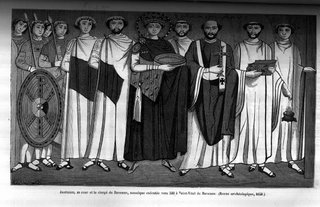
The Emperor Justinian and his court and clergy, c.510


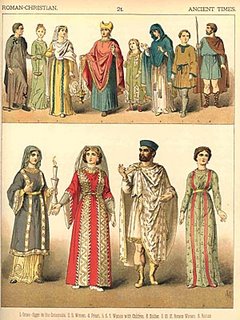
Late Roman and "Byzantine" dress is more body covering than earlier Roman costume, usually including long sleeves and long hems. This is generally assumed to be a reaction to the growing Christian view that the body was not beautiful, but a pit of vice. When the tunica is shorter (only on men) the lower limbs are encased in trousers, a "barbarian" invention first adopted by the Roman army and lower classes, and eventually (after some aristocratic resistance) by all men. The toga remained for emperors and other high officials in this period, but in vestigial form as a long thin (about 6") strip wrapped round the torso in the traditional manner .

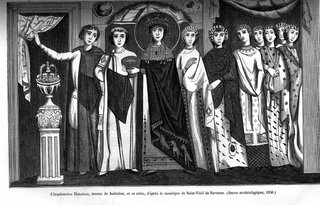
The Empress Theodora, wife of Justinian, and her suite, c. 510


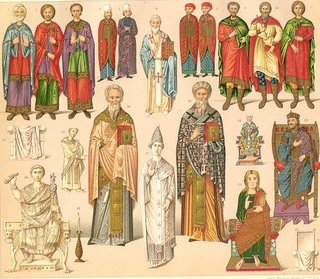
Long half circle capes were part of male court dress, worn in place of the old toga over the new long sleeved tunica. The most notable feature of the Eastern Empire's dress is it's surface decoration. Unlike the earlier period which left fabric largely undecorated, the people of the Byzantine/Romanian Empire used all manner of woven, embroidered and beaded surface embellishment, particularly on Church vestments and court dress. This style of decoration, and many of the garment shapes, survive to this day in the priestly vestments of Orthodox churches in Greece, Eastern Europe and Russia.
Dress in Early Medieval Europe (400-1200ce)
Contemporary with the first part of the Eastern Empire's rule in the western Mediterranean, Western Europe was going through the period known as the "Dark Ages". One rather pithy scholar pretty well summed up the era (400-900ce) as "five hundred years of camping out". Warfare was pretty constant, commerce pretty nearly dead, and stable social and educational institutions almost non-existent.
Few records survive of dress in this period, although there is some rather spectacular jewelry in the style commonly called Celtic which has mainly been found in archeological sites in the British Isles and the Nordic countries. Like the Eastern Empire the dress of Western Europe seems to have consisted of the long sleeved tunic, half circle capes, & trousers. Western men are more often depicted in the short tunic and trouser combination than in long tunics. Shoes and boots were also worn in place of sandals.
It has been suggested that the reason that clothing became longer, heavier and more fitted in this era is that the world weather pattern shifted at that time to make Europe the much colder continent it is now. (In Roman times the weather was so warm in Northern Europe that they had successful vineyards in England, far north of where it is possible to grow them now).
Another clothing variation popular in Europe was the wearing of a short tunic over a longer fuller one. This was done by persons of both sexes. The over tunic was often heavily embroidered in a manner similar to the Byzantine style.
Women's dress was often similar to the style mentioned above, or simply consisted of a long tunic with a more tight fitting sleeved one beneath. Married women, with the exception of queens, generally veiled their hair, but this was not a hard and fast rule.
In 800ce Charles the Great (aka Charlemagne) was crowned "Holy Roman Emperor" by the Pope in Rome, thus setting up a smaller, rival empire in the West to Romania/Byzantium. In this period (known now as Carolinian) the shape of the old tunic changed by widening at the bottom. Eventually the lower part of the garment (now more often referred to as a gown) was cut like a full skirt.
By the 1000-1200 ce period known as "Early Gothic" (another name intended as a pejorative provided by people at a much later date) the usual cut of the gown (and shorter over tunics) was pretty usually with the wide or circular bottom. Sleeves on the over gowns and/or tunics get wider (especially on women's dress) and there is an overall fashion for conspicuous consumption of fabric.
There had been a pretty popular belief in Western Europe in the years leading up to the first Millennium, that the Christian Second Coming, End of the World, and Judgment Day would happen in the year 1000. This did not really encourage people to build earthly cities for the future or spend time or cash on worldly matters. So material culture, including dress, was pretty limited in it's ostentation before this date. When the world did not end, people in the centuries that followed became more sanguine that The End was not Near, and began displaying more interest in frivolous worldly matters such as dressing better than one's neighbors. This is partly why conspicuous consumption of fine fabric suddenly became popular.


Byzantine court and ecclesiastical dress from

Sunday, November 05, 2006

Etruria

Cultural development came later to Italy than to the Aegean area. The Greeks colonized southern Italy and Sicily from the later 7th century BC, but it was the Etruscans who introduced a high standard of civilization, in the previous century, to the central region of the peninsula. They called themselves the Rasenna (though in Latin they were known as the Etrusci or Tusci). It is believed that they may have emigrated from Anatolia or possibly from farther east. They quickly developed their culture in their new land and, soon after 700 BC, they were living in an urban society capable of a high standard of building and visual arts. In dress, as in the other applied arts, they drew their inspiration and knowledge from a mixture of sources, chiefly Greek and Oriental.
Etruscan society appears to have had more in common with the Minoan culture than with that of Classical Greece. This was true, for example, of the position of women. Unlike the custom in Greece and Rome, where women were relegated to a submissive, domestic role, in Etruria women shared all the activities of life with men. The wealth of pictorial evidence that exists, chiefly the coloured frescoes and sculpture found in the great burial places such as the necropolis at Tarquinia, depicts women taking full part at banquets, dances, and concerts as well as attending racing, athletic, and other types of contests. These sources also indicate a close affinity of dress with the Minoan, illustrating sewn, fitted garments, bright colouring, rich decoration, and an abundance of beautiful jewelry—a craft at which the Etruscans excelled, especially in gold. Nevertheless, Etruscan dress, for both sexes, demonstrates a marriage between East and West, blending Eastern features from Egypt, Syria, and Crete with a later Ionian-style draped attire probably derived from the contemporary Greek colonists in southern Italy. Thus, Etruscans can be seen wearing both draped, pinned tunics and fitted, sewn ones, or such Greek styles as the chlamys, himation, or chiton in conjunction with footwear with Middle Eastern-style turned-up toes. Some Etruscan garments presaged later styles; for example, the tebenna, a semicircular mantle, was an early version of the Roman toga, and a decorative collar derived from Egypt anticipated a later Byzantine version.


Etruscan musicians wearing tunics, cloaks similar to the Greek chlamys, and sandals. Detail from a … Scala/Art Resource, New York City